
Product Researcher | Specializing in bathroom products and home textiles
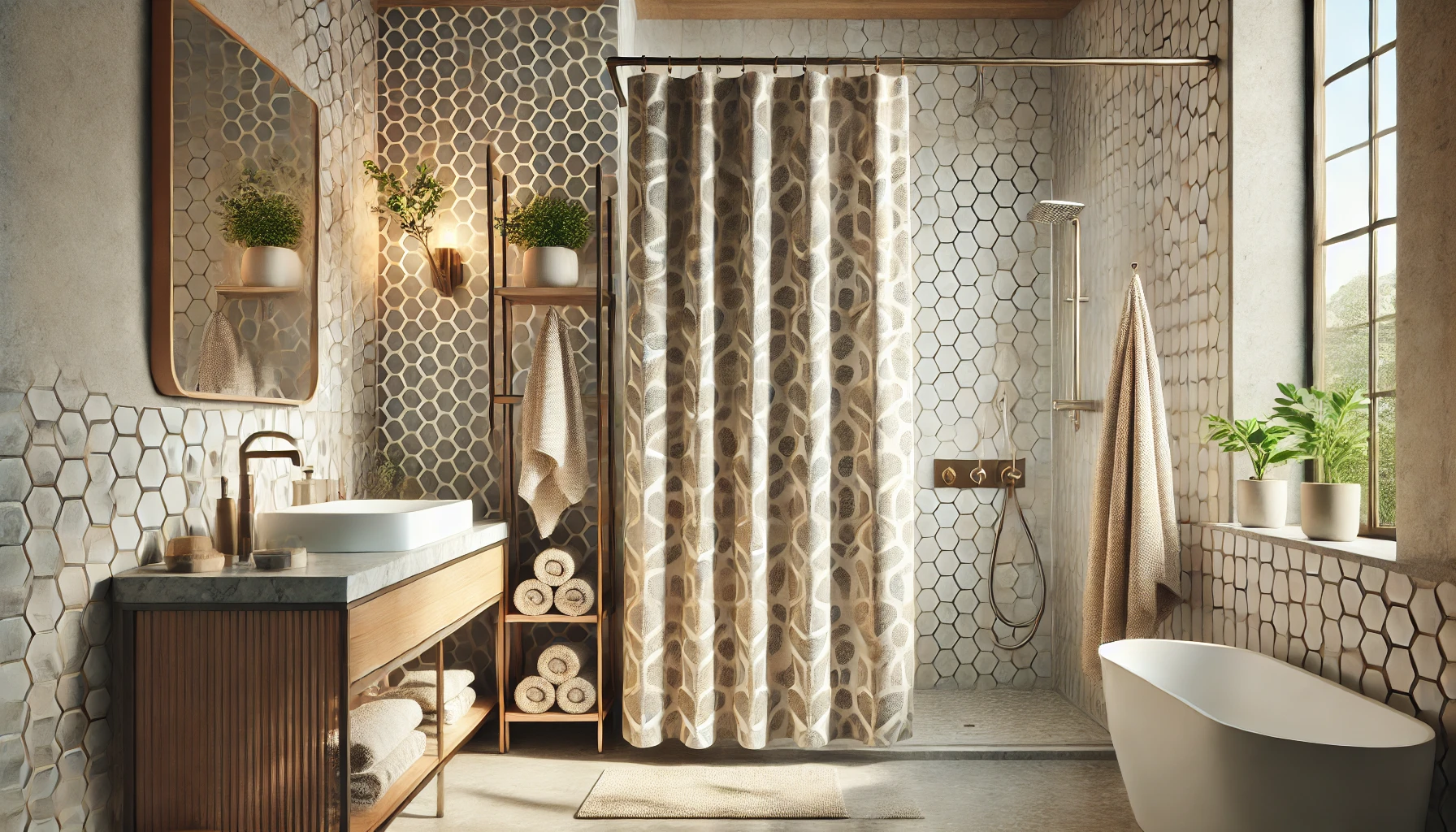
The right shower curtain does far more than keep water in the tub — it shapes your health, protects your home, and defines your bathroom's personality
ALYVIA SPRING Hotel Quality Shower Curtain
Built-in waterproof liner, fabric feel, weighted magnetic hem, 56,746 reviews at 4.5/5
The Short Answer
The right shower curtain matters because it is the only daily-touch surface in your bathroom that compounds across health, money, and home protection at the same time. A $15 PVC vinyl liner replaced four times a year runs you $60 annually and quietly off-gases VOCs every time you turn on hot water; a $30 PEVA or polyester curtain replaced once a year costs $30 and skips the chemistry entirely. A heavy 230 GSM fabric drapes like a luxury hotel and resists the inward billow that thin 130 GSM panels surrender to within seconds.
Size matters just as much. A curtain that ends 12 inches above the tub floor — or stops 6 inches short on the sides — sends water onto your bath mat, into your grout, and behind your baseboards, where mildew and rotted subfloor show up within months. Get the material, weight, and size right once and you spend less, breathe cleaner, and protect a $1,000 to $5,000 floor repair for the price of a sandwich.
Most people spend less than two minutes choosing a shower curtain. They walk into a store or scroll through Amazon, pick something cheap and inoffensive, toss it in the cart, and move on. After all, it is just a piece of fabric or plastic that hangs in the shower, right? How much could it really matter?
As it turns out, it matters a lot more than you would expect. Your shower curtain is one of the most silently influential objects in your home. It touches your health every single day through the chemicals it may release and the mold it may harbor. It protects — or fails to protect — your bathroom from water damage that can cost thousands of dollars to repair. It dominates the visual landscape of your bathroom more than any other single item, affecting how the room feels, how guests perceive your home, and even how much your house is worth. And the difference between a curtain that serves you well and one that quietly undermines your wellbeing often comes down to just a few dollars and a few minutes of informed decision-making.
This guide exists because we believe the humble shower curtain deserves more respect. Over the following sections, we are going to walk through the seven major ways your shower curtain choice impacts your daily life — from health and home protection to style, comfort, environmental responsibility, and long-term value. By the end, you will never look at a shower curtain the same way again. And you will have the knowledge to choose one that genuinely works for you.
Let us start with the factor that most people never consider but arguably matters the most.
Table of Contents
Your Shower Curtain Affects Your Health
When you step into a hot shower and close the curtain, you are creating a sealed, steam-filled environment. The temperature rises, humidity approaches 100 percent, and your lungs are breathing in whatever the air contains. In this environment, the materials surrounding you matter enormously — and your shower curtain is the largest material surface in that enclosed space.
The Hidden Danger of Cheap Vinyl (PVC) Curtains
Traditional vinyl shower curtains are made from polyvinyl chloride, commonly known as PVC. To make rigid PVC flexible enough to use as a curtain, manufacturers add chemical plasticizers — most commonly phthalates — along with stabilizers that often include organotins, a class of compounds with known toxic properties. When these curtains are exposed to the heat and moisture of a shower, those chemicals do not stay locked in the plastic. They off-gas into the air as volatile organic compounds (VOCs) that you then inhale directly into your lungs.
A landmark study by the Center for Health, Environment and Justice researched top-rated shower curtains and found that they released over 108 different VOCs, some of which persisted in the air for more than 28 days after the curtain was first hung. The chemicals detected included toluene (associated with respiratory irritation and nervous system effects), ethylbenzene (linked to organ damage with prolonged exposure), and xylenes (which can cause headaches, dizziness, and nausea). That "new shower curtain smell" many people recognize is not just an annoyance — it is a chemical exposure event happening in one of the most enclosed, poorly ventilated rooms in your house.
The health implications are particularly concerning for vulnerable populations. Children, pregnant women, elderly individuals, and anyone with pre-existing respiratory conditions like asthma face elevated risks from VOC exposure. Even for healthy adults, daily exposure to low-level VOCs in a steam-filled, enclosed space adds up over months and years. The simple act of choosing a non-PVC curtain eliminates this exposure entirely.
Health Warning: PVC Shower Curtain Red Flags
- Strong chemical or plastic smell when you open the package
- Product is labeled "vinyl" without specifying PEVA or EVA
- Extremely low price point (under $5) with no material specification
- Headaches, nausea, or respiratory irritation after showering with a new curtain
- Oily film on the curtain surface that transfers to your hands
Our recommendation: Always choose PEVA, EVA, or polyester fabric curtains instead. The price difference is negligible — often less than $2 — and the health benefit is significant.
Mold and Mildew: The Silent Health Threat
Even if your shower curtain is made from perfectly safe materials, it can still become a health hazard if it develops mold or mildew. And given that your shower curtain lives in the wettest, warmest environment in your house, mold growth is not a matter of "if" but "when" — unless you actively prevent it.
Mold on a shower curtain releases microscopic spores into the air every time you open, close, or brush against it. These spores are small enough to penetrate deep into your lungs. For people with mold allergies — which the Asthma and Allergy Foundation of America estimates affects 10 to 20 percent of the population — exposure causes symptoms ranging from sneezing, runny nose, and itchy eyes to severe asthma attacks. But even people without diagnosed allergies can experience respiratory irritation, chronic coughing, and a persistent "stuffy" feeling from ongoing mold spore exposure in an enclosed bathroom.
The type of curtain you choose directly impacts mold risk. PEVA and treated polyester curtains resist mold growth significantly better than untreated cotton or cheap vinyl. Products like the Barossa Design PEVA Liner, which uses non-porous PEVA material, give mold virtually nothing to feed on. The smooth, non-absorbent surface dries quickly and does not trap the organic matter (soap residue, body oils, dead skin cells) that mold colonies need to establish themselves. Fabric curtains treated with mildew-resistant coatings offer similar protection while providing a more upscale aesthetic.
Key takeaway: Your shower curtain choice directly impacts the air quality in your bathroom. Avoid PVC vinyl entirely, choose materials that resist mold growth, and maintain your curtain properly. These simple steps eliminate two of the most common sources of bathroom air pollution.
Water Damage Prevention: Your Curtain as Home Protection
Your shower curtain has a job that goes far beyond aesthetics: it is the primary barrier that keeps water inside your tub or shower enclosure and off your bathroom floor. When it fails at this job — even partially — the consequences can be shockingly expensive.
The True Cost of Water Escaping Your Shower
A single shower sends approximately 17 to 25 gallons of water cascading down inside your tub. Every one of those gallons is looking for a way out. Your shower curtain, when properly sized, weighted, and positioned, prevents that water from reaching your floor. But when the curtain is too short, too narrow, lacks weight at the bottom, or simply is not waterproof enough, water escapes. Not in dramatic floods — but in small, persistent amounts that you might barely notice during any single shower.
That is what makes water damage so insidious. A tablespoon of water on the bathroom floor after each shower seems trivial. But multiply that by 365 showers a year, and you have gallons of water that have seeped into floor grout, crept under baseboards, and saturated the subfloor beneath your tiles or vinyl. Over a year or two, this seemingly insignificant daily exposure creates conditions that are perfect for structural damage.
The numbers tell a sobering story. According to insurance industry data, the average cost of bathroom water damage repair ranges from $1,000 to $5,000 for moderate cases. Severe cases involving subfloor replacement, mold remediation behind walls, and fixture removal can exceed $10,000. And here is the part that frustrates homeowners the most: most of these repairs trace back to chronic, low-level water exposure rather than dramatic flooding — exactly the kind of exposure that a proper shower curtain prevents.
What Proper Water Containment Looks Like
An effective shower curtain setup requires attention to these details:
- Full width coverage: The curtain should extend at least 4-6 inches past the edge of the tub on both sides
- Correct length: The bottom of the curtain should hang inside the tub, not above it
- Bottom weight: Magnets or weighted hems keep the curtain pressed against the tub wall
- Waterproof barrier: Either a standalone waterproof curtain or a decorative curtain paired with a waterproof liner
- No gaps: The curtain should be fully closed during every shower, with no bunching that creates gaps at the edges
Curtain Features That Prevent Water Damage
Not all shower curtains are equally effective at water containment. The features that make the biggest difference are ones you might not think to look for when shopping:
Weighted or magnetized bottom hems are perhaps the single most important feature for water containment. They keep the curtain pressed against the tub wall, preventing splash-out at the base where water most commonly escapes. Products like the ALYVIA SPRING Hotel Quality curtain include built-in weighted magnets that hug the tub surface, creating a seal that holds even during high-pressure showers.
Proper material waterproofing is the other critical factor. A decorative fabric curtain alone will let water pass through the weave over time, which is why pairing fabric curtains with a waterproof liner is essential. Alternatively, dual-layer curtains like the ALYVIA SPRING combine a fabric exterior with a waterproof inner lining, giving you both aesthetics and protection in a single curtain.
Correct sizing seems obvious but is frequently gotten wrong. A curtain that is even two inches too short will leave a gap between its bottom edge and the tub floor where water streams out freely. Always measure your specific tub-to-rod distance before purchasing, and when in doubt, choose a slightly longer option — excess length inside the tub does no harm, while insufficient length causes real damage.
The Style Factor: The Biggest Visual Element in Your Bathroom
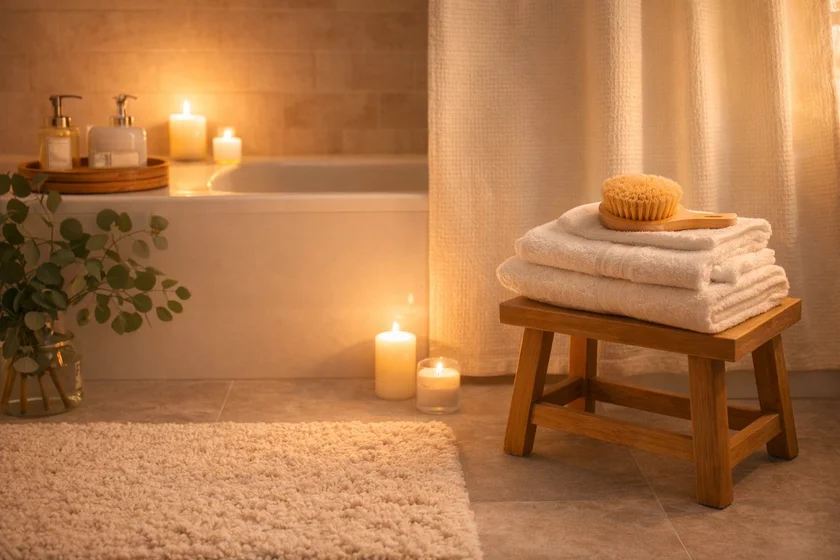
Your shower curtain occupies more visual space than any other single element in most bathrooms — making it the most impactful design decision in the room
Walk into any bathroom and take a quick mental inventory of what your eyes register first. In most bathrooms — especially those with a standard tub-shower combo — the shower curtain dominates the visual field. It occupies more square footage of wall space than the mirror, the vanity, the towel rack, or any piece of wall art. It is, quite simply, the largest design element in the room. And yet, it receives less design thought than almost anything else.
This mismatch between visual impact and attention paid creates a massive opportunity. Because the shower curtain is so visually dominant, upgrading it delivers an outsized return on both investment and effort. A $10-20 curtain swap can transform the entire feel of a bathroom in under five minutes — no paint, no renovation, no tools required.
How Your Curtain Shapes the Room
The design principles at work here are straightforward but powerful:
Color sets the mood. A white or light-colored curtain makes a small bathroom feel larger and brighter by reflecting light and creating a sense of openness. A deep, saturated color like sage green or navy creates intimacy and a spa-like ambiance. A bold pattern or bright accent color turns the curtain into a focal point that energizes the entire space. The Dynamene Sage Green Waffle Curtain, for example, brings a calming, nature-inspired warmth that instantly transforms a stark white bathroom into an inviting retreat — all for $15.99.
Texture adds depth. Flat, smooth curtains look generic and forgettable. Textured materials — waffle weave, slub fabric, linen-look polyester — create visual interest through light and shadow. They look deliberately chosen rather than simply purchased. This is one of the reasons waffle weave curtains have exploded in popularity: the dimensional texture reads as "designed" and "intentional" in a way that flat fabric never can.
Material communicates quality. Humans subconsciously assess the quality of a space through material cues. A heavy, well-draping fabric curtain signals care and investment. A thin, crinkly plastic liner signals the opposite. Even if visitors never consciously think about your shower curtain, they register these cues and form impressions about your home accordingly. This matters especially if you are selling your home — real estate agents consistently rank shower curtain upgrades among the highest-impact, lowest-cost staging improvements.
Quick Style Guide by Bathroom Type
- Small bathrooms: White or light neutral waffle weave — opens the space visually
- Master bathrooms: Textured fabric in a rich color (sage, charcoal, navy) — spa-like sophistication
- Guest bathrooms: Hotel-style white fabric with built-in liner — universally appealing and low-maintenance
- Kids' bathrooms: Colorful, fun patterns on waterproof material — easy to clean and replace
- Rental apartments: Neutral fabric curtain you can take with you when you move
The $15 Bathroom Makeover
Interior designers use a concept called "cost per visual square foot" to evaluate design investments. By this metric, a shower curtain is one of the most efficient purchases you can make. Consider: a 72x72 inch shower curtain covers 36 square feet of visual space. At $15, that works out to roughly $0.42 per square foot of visual transformation. By comparison, painting a bathroom wall costs $2-5 per square foot (plus labor and drying time), new tile runs $10-25 per square foot (plus installation), and bathroom wallpaper costs $3-8 per square foot (plus the headache of dealing with moisture).
A curtain like the Dynamene Sage Green Waffle delivers designer-level visual impact — the waffle texture, the sophisticated color, the heavy drape — at a fraction of the cost and effort of any other bathroom update. You open the package, hang it on existing hooks, and the transformation is immediate. No contractor, no weekend project, no mess. It is arguably the most accessible design upgrade available in any room of your home.
Comfort and Functionality: The Daily Experience
You interact with your shower curtain at least once every single day. You open it, close it, brush against it, and exist within its enclosed space for the duration of your shower. These interactions are so routine that you probably stopped noticing them long ago. But the wrong curtain makes every one of those interactions slightly worse — and the right curtain makes them seamlessly, invisibly pleasant.
The Billowing Problem
If you have ever been mid-shower and had the curtain suddenly suck inward and plaster itself against your legs or back, you know the particular annoyance of shower curtain billowing. It is startling, uncomfortable, and breaks the one moment of peace and quiet many people get in their entire day.
The cause is physics. Known as the Bernoulli effect (or sometimes the "shower curtain effect"), it happens because the hot water heats the air inside the shower, causing it to rise. This creates a low-pressure zone inside the shower enclosure. The cooler, higher-pressure air outside the curtain pushes the curtain inward to fill that pressure gap. The thinner and lighter your curtain is, the more dramatically it billows.
The solution is straightforward: use a heavier curtain. This is one of the strongest arguments for investing in a quality fabric curtain rather than using a flimsy, lightweight liner as your primary shower enclosure. Heavy-weight polyester curtains — particularly waffle weave designs — have enough mass to resist the pressure differential and stay in place. Curtains with weighted or magnetized bottom hems add additional anchoring that keeps the bottom edge pressed against the tub wall, further preventing billowing. The ALYVIA SPRING Hotel Quality curtain excels here, combining fabric weight with built-in magnetic hems for a curtain that stays exactly where you put it.
The Cling Factor
Closely related to billowing is "cling" — when a curtain (particularly a thin plastic liner) adheres to your wet skin. The sensation is universally disliked, and it is a major reason why people who switch from a plastic liner to a fabric curtain or fabric liner describe the experience as "life-changing." Fabric surfaces do not cling to skin the way smooth PEVA or vinyl surfaces do. If cling is a daily frustration for you, upgrading to a fabric-based solution immediately eliminates the problem.
Ease of Use
The small functional details of a shower curtain add up to a significantly different daily experience:
- Hook compatibility: Curtains with reinforced grommets that glide smoothly on standard hooks make opening and closing effortless. Cheap curtains with thin or poorly positioned grommets snag, stick, and resist sliding — a minor frustration that compounds over hundreds of uses.
- Drying speed: Curtains made from materials that dry quickly (PEVA, treated polyester) spend less time damp, which means less mildew, less musty smell, and a more pleasant bathroom environment. Thick, untreated cotton curtains absorb water and can take hours to dry, creating extended opportunities for mold growth.
- Maintenance burden: A machine-washable curtain that resists mildew requires minutes of maintenance per month. A curtain that needs constant scrubbing, spot-treating, and eventual replacement adds hours of unwanted housework over the course of a year. All three products we recommend later in this guide — the ALYVIA SPRING, Dynamene Sage Green Waffle, and Barossa Design PEVA — are fully machine washable.
- Installation simplicity: Standard grommet-and-hook curtains are universally simple to install. Some modern designs take this further with snap-in systems that eliminate hooks entirely, cutting installation time to under a minute.
The comfort test: After your next shower, pay conscious attention to every interaction you had with your curtain. Did it billow or cling? Was opening and closing smooth? Does it look and smell fresh? If the answer to any of these is no, the curtain is subtracting from your daily quality of life — and a simple upgrade will fix it.
Environmental Impact: PEVA vs. PVC and the Eco-Friendly Choice
Shower curtains sit at a surprising intersection of environmental concern. Americans purchase an estimated 300 million shower curtains and liners every year. The vast majority of these are made from plastic-based materials that will persist in landfills for centuries after being discarded. The material you choose, how long it lasts, and how you dispose of it all carry meaningful environmental consequences — especially when multiplied across hundreds of millions of households.
PVC: The Environmental Problem Child
PVC (polyvinyl chloride) is the most environmentally damaging common shower curtain material. Its problems span the entire lifecycle:
- Manufacturing: PVC production requires chlorine, which generates dioxins — among the most toxic man-made chemicals known — as a byproduct. The manufacturing process also involves phthalate plasticizers and heavy metal stabilizers, creating additional waste streams.
- In-use emissions: As discussed in the health section, PVC curtains off-gas VOCs throughout their lifespan, releasing chemicals into both indoor air and eventually outdoor air as ventilation carries them out of your home.
- Disposal: PVC is extremely difficult to recycle. Most recycling facilities cannot process it, and when it is incinerated in waste-to-energy facilities, it releases hydrochloric acid and additional dioxins. In landfills, PVC persists essentially forever, slowly leaching plasticizers and heavy metals into surrounding soil and groundwater.
- Short lifespan: Cheap PVC curtains typically last only 3 to 6 months before cracking, yellowing, or becoming too mildewed to use. This rapid replacement cycle means a single household can send 2 to 4 PVC curtains to the landfill per year — 20 to 40 over a decade.
PEVA: The Better Plastic Option
PEVA (polyethylene vinyl acetate) represents a significant environmental improvement over PVC while maintaining the same waterproof performance. PEVA is chlorine-free, which eliminates dioxin production during manufacturing. It does not require phthalate plasticizers, reducing both in-use chemical emissions and disposal toxicity. While PEVA is still a plastic and still persists in landfills, it poses fewer chemical risks at every stage of its lifecycle.
The Barossa Design PEVA Liner is an excellent example of a PEVA product done right. It provides 100% waterproof protection without any of the toxic chemical concerns associated with PVC. Its heavier-gauge construction also means it lasts longer than cheap vinyl alternatives — typically 8 to 12 months of regular use — which reduces the number of replacements heading to landfills each year.
The Most Sustainable Choice: Buy Quality, Replace Less
Beyond material choice, the single most impactful environmental decision you can make about your shower curtain is choosing one that lasts. A high-quality polyester fabric curtain that survives two years of daily use with proper maintenance produces less waste than four cheap vinyl liners cycled through the same period. The manufacturing energy, packaging material, and transportation emissions are all reduced when you replace less frequently.
This is the environmental argument for investing in a quality product even when cheaper alternatives exist. A $15.99 Dynamene Sage Green Waffle that lasts 18 months generates less waste and fewer emissions than three $5 vinyl liners consumed over the same period. The financial savings and the environmental savings point in the same direction: buy better, buy less often.
Environmental Impact Comparison
| Factor | PVC Vinyl | PEVA | Polyester Fabric |
|---|---|---|---|
| Chlorine-free | No | Yes | Yes |
| VOC emissions | High | Low | Minimal |
| Typical lifespan | 3-6 months | 6-12 months | 1-2 years |
| Recyclable | Rarely | Limited | Some programs |
| Replacements per decade | 20-40 | 10-20 | 5-10 |
Cost vs. Value: Why the Cheapest Option Is Rarely the Most Economical
There is a persistent myth in shower curtain shopping that goes something like this: "It is just a shower curtain. Buy the cheapest one, and when it gets gross, throw it away and buy another cheap one." On the surface, this logic seems sound. But when you actually run the numbers, the "buy cheap, replace often" approach almost always costs more over time than buying a quality product once.
The Math of Cheap vs. Quality
Let us compare two real scenarios over a two-year period:
Scenario A: The Cheap Vinyl Approach
- Purchase a $4.99 PVC vinyl curtain every 3-4 months
- Over 2 years: 6 to 8 replacements = $29.94 to $39.92
- Plus: exposure to VOCs, mold risk, potential water damage from inadequate curtains, time spent shopping and replacing
Scenario B: The Quality Investment Approach
- Purchase a $15.99 Dynamene Sage Green Waffle curtain + a $9.99 Barossa Design PEVA Liner = $25.98
- Fabric curtain lasts 2 years; PEVA liner replaced once at month 10 = $9.99
- Over 2 years: $35.97 total
- Plus: no VOC exposure, superior mold resistance, reliable water containment, dramatically better aesthetics, minimal maintenance time
The total cost difference over two years is negligible — roughly $4 to $6 depending on exact replacement timing. But the quality approach delivers vastly superior performance, aesthetics, health outcomes, and convenience. When you factor in the value of time spent shopping for and replacing cheap curtains (even at minimum wage, four unnecessary shopping trips cost more than the price difference), the quality approach actually comes out ahead financially.
The Water Damage Insurance Argument
Perhaps the strongest financial argument for a quality shower curtain is the water damage it prevents. As discussed earlier, chronic water escape from an inadequate shower curtain can result in repair costs ranging from $1,000 to $10,000 or more. A proper curtain-and-liner system costing $20-30 provides daily protection against this risk for one to two years. On a cost-per-day basis, that works out to roughly $0.03 to $0.08 per day for meaningful home protection — a better rate than virtually any insurance policy.
When you frame it this way, the question is not whether you can afford a quality shower curtain. The question is whether you can afford not to have one.
The value equation: A quality shower curtain is not a luxury purchase — it is a utility purchase that also happens to look good. The $10-20 price range delivers the best balance of durability, aesthetics, health safety, and water protection. Going cheaper costs more in the long run. Going significantly more expensive provides diminishing returns. The sweet spot is right where the best-selling, highest-rated curtains live.
Signs You Need a New Shower Curtain: The Complete Checklist
Many people keep their shower curtain far longer than they should, either because they do not notice the gradual deterioration or because replacing it never quite makes it onto the to-do list. But a curtain past its prime is not just unattractive — it is actively failing at its job of protecting your health and your home. Here is how to know when it is time for a fresh start.
Replace Your Shower Curtain If You Notice Any of These Signs
- Persistent musty or mildew smell that does not go away after machine washing. This indicates mold has penetrated the material fibers beyond what surface cleaning can address.
- Visible black, pink, or orange mold spots that return within days of cleaning. Pink and orange discoloration is often Serratia marcescens bacteria, which thrives in moist environments and can cause infections in people with compromised immune systems.
- Yellowing or discoloration on a curtain that was originally white or clear. This indicates chemical degradation of the material, particularly common in PVC and lower-quality PEVA.
- Tears, cracks, or holes in the material. Even small tears compromise the curtain's water containment, and they rapidly expand with continued use.
- Stiffness or brittleness in a PEVA or vinyl curtain. When the material becomes rigid and crackly instead of flexible, the plasticizers have leached out, and the curtain is both less effective and more likely to release chemical residues.
- Water is getting past the curtain regularly. If you consistently find water on the floor after showering despite closing the curtain properly, the material may have lost its water-repellent properties, or the curtain may have shrunk from repeated washing.
- Soap scum buildup that will not wash out. Permanent mineral and soap deposits indicate the curtain's surface has degraded enough to trap residue in the material rather than shedding it during washing.
- Rust stains around the grommets. Even "rust-resistant" grommets can corrode over time, staining the curtain and potentially your tub. If the grommets are discolored, the curtain has reached the end of its useful life.
- You cannot remember when you bought it. If you genuinely have no memory of purchasing your current shower curtain, it has almost certainly been there too long. PEVA liners should be replaced every 6-12 months; fabric curtains every 1-2 years.
If you checked even one item on this list, your current shower curtain is overdue for replacement. If you checked three or more, replacing it should be a priority — both for your health and for the condition of your bathroom. The good news is that excellent replacements are affordable, widely available, and easy to install. Here are our top recommendations.
Our Recommended Starting Points
Based on everything we have discussed — health, water protection, style, comfort, environmental responsibility, and long-term value — here are three products that represent the best starting points for anyone looking to upgrade their shower curtain. Each one addresses the concerns outlined in this guide while delivering excellent performance at an accessible price.
ALYVIA SPRING Hotel Quality Shower Curtain
The ALYVIA SPRING is the ideal recommendation for readers of this guide because it addresses virtually every concern we have discussed in a single, sub-$10 product. The soft fabric exterior eliminates the cheap plastic look and feel that plagues vinyl curtains, while the built-in waterproof lining provides complete water containment without needing a separate liner. The material is non-toxic and free from the VOC concerns associated with PVC vinyl. Weighted magnets at the bottom keep the curtain pressed against the tub wall, preventing both billowing and water escape.
With nearly 57,000 reviews and a consistent 4.5 rating, this curtain has proven its reliability across tens of thousands of bathrooms. It is machine washable for easy maintenance, available in neutral colors that suit any decor, and provides the hotel-quality appearance that instantly elevates a bathroom's perceived quality. For anyone who wants a simple, one-purchase solution that checks every box outlined in this article, the ALYVIA SPRING is where to start.
- Material: Fabric exterior + waterproof inner lining (non-toxic)
- Health safe: No PVC, no VOCs, mildew-resistant
- Water protection: Built-in waterproof layer + weighted magnetic hem
- Style: Clean hotel-quality appearance in neutral tones
- Maintenance: Machine washable, lasts 12+ months
Dynamene Sage Green Waffle Shower Curtain
If the style section of this guide resonated with you — if you recognize that your shower curtain is the biggest design opportunity in your bathroom — the Dynamene Sage Green Waffle is the product to consider. The waffle weave texture creates the dimensional, designed look that flat curtains cannot achieve, while the sage green color brings a calming, nature-inspired warmth that interior designers consistently rank among the most appealing bathroom tones. It is the kind of curtain that guests notice and compliment.
Beyond aesthetics, the Dynamene checks the practical boxes. The heavy-weight polyester is naturally resistant to mold and mildew, does not release VOCs, and provides enough weight to resist billowing and cling. It is machine washable and maintains its color and texture through repeated wash cycles. The fabric is water-resistant — not fully waterproof — so we recommend pairing it with a PEVA liner for complete water containment. At $15.99 with over 22,000 reviews and a 4.6 rating, it delivers designer-level visual impact at a drugstore price point.
- Material: Heavy-weight polyester waffle weave (non-toxic)
- Health safe: No PVC, no VOCs, mildew-resistant fabric
- Water protection: Water-resistant; pair with PEVA liner for full protection
- Style: Textured waffle weave in trending sage green — high visual impact
- Maintenance: Machine washable, lasts 18-24 months
Barossa Design PEVA Shower Curtain Liner
The Barossa Design PEVA Liner is the product that ties the entire health and water-protection argument together. If your current setup uses a cheap PVC vinyl liner — or no liner at all — replacing it with this PEVA alternative immediately eliminates VOC exposure, improves water containment, and reduces mold risk. At $9.99, it is one of the most impactful sub-$10 purchases you can make for your bathroom.
What sets the Barossa apart from the dozens of other PEVA liners on the market is its construction quality, reflected in an extraordinary 91,634 reviews. The heavy-gauge PEVA material hangs with enough weight to stay in place against the tub wall. Reinforced grommets resist tearing even after months of daily use. The material is non-toxic, chlorine-free, and has no chemical smell out of the package. It pairs perfectly with a decorative fabric curtain like the Dynamene — giving you a two-curtain system that maximizes both style and waterproof performance.
- Material: Heavy-gauge PEVA (non-toxic, chlorine-free)
- Health safe: No PVC, no chlorine, no VOCs, no chemical smell
- Water protection: 100% waterproof — complete water containment
- Style: Clear/frosted functional liner — pair with decorative curtain
- Maintenance: Machine washable, replace every 8-12 months
Frequently Asked Questions
Yes, a shower curtain can negatively affect your health in two primary ways. First, cheap PVC vinyl curtains release volatile organic compounds (VOCs) — including phthalates and organotins — that you inhale during hot showers. Research has found that PVC curtains can release over 100 different VOCs. Second, any shower curtain that develops mold and mildew releases spores into the air that can trigger respiratory issues, allergies, and asthma symptoms. Choosing non-toxic materials like PEVA or polyester and maintaining your curtain properly significantly reduces these health risks.
Replacement frequency depends on the material. PEVA liners like the Barossa Design should be replaced every 6 to 12 months. Fabric polyester curtains like the Dynamene Sage Green Waffle can last 1 to 2 years with proper care — including monthly washing and spreading the curtain to dry after each shower. Signs you need a replacement include persistent musty odors that survive laundering, visible mold or mildew that will not wash out, yellowing or discoloration, tears or cracks in the material, and the curtain no longer repelling water effectively.
Yes, PEVA is significantly safer than PVC. PEVA (polyethylene vinyl acetate) is chlorine-free and does not release harmful VOCs like traditional PVC vinyl. PVC shower curtains contain chlorine and plasticizers including phthalates that can off-gas into your bathroom, especially in the steam and heat of a shower. PEVA provides the same waterproof performance as PVC without the toxic chemical concerns. The price difference is minimal — the Barossa Design PEVA Liner costs just $9.99 — making PEVA the clear choice for health-conscious buyers.
Absolutely. A shower curtain that is too short, too narrow, lacks weight at the bottom, or does not have adequate waterproof properties will allow water to escape onto your bathroom floor during every shower. Over time, this repeated water exposure can cause warped flooring, rotting subfloor, mold growth behind walls and baseboards, damaged cabinetry, and peeling paint. The average water damage repair costs between $1,000 and $5,000, making a proper shower curtain and liner combo — like the ALYVIA SPRING Hotel Quality at $9.98 — one of the cheapest forms of home protection available.
Organic cotton and hemp are the most eco-friendly raw materials, though they require a waterproof liner to function. For a single-curtain solution, PEVA is more environmentally friendly than PVC because it is chlorine-free and produces fewer toxic byproducts during manufacturing and disposal. However, the most sustainable overall approach is choosing a durable product — like a high-quality polyester waffle curtain — that you replace infrequently. A $16 curtain that lasts two years produces less waste than four $5 vinyl curtains consumed over the same period.
Shower curtain billowing is caused by the Bernoulli effect. Hot shower water heats the air inside the shower, causing it to rise. This creates a low-pressure zone inside the shower enclosure, and the higher-pressure air outside pushes the curtain inward. To prevent this, choose a heavier curtain with more body and weight — waffle weave polyester curtains like the Dynamene Sage Green are excellent at resisting billowing. You can also use a curtain with a weighted or magnetized bottom hem, install curtain clips or suction cups along the tub wall, or switch from a thin plastic liner to a thicker fabric-based option.
The shower curtain is typically the single largest visual element in a bathroom, occupying more wall space than any other item. A well-chosen curtain can make a dated bathroom look modern, make a small bathroom feel larger with light colors and textures, and create a cohesive design that impresses buyers during home viewings. Real estate agents frequently recommend upgrading shower curtains before listing a home because it is one of the lowest-cost, highest-impact staging improvements. A $10 to $20 curtain upgrade — especially one with texture and a trending color — can meaningfully change how buyers perceive an entire bathroom.
Related Guides
The Bottom Line
Your shower curtain is not just a piece of fabric hanging in your bathroom. It is a health barrier that determines what chemicals and mold spores you breathe during your daily shower. It is a structural protector that stands between normal bathroom operation and thousands of dollars in water damage. It is a design element with more visual impact than anything else in the room. It is a daily-use object whose comfort and functionality affect how you start or end every single day. And it is an environmental choice that either contributes to or reduces household waste.
The difference between a shower curtain that works against you and one that works for you is rarely more than $10 to $15 and five minutes of installation time. With the information in this guide, you now know exactly what to look for, what to avoid, and when to replace. The only step left is to take action.
Whether you choose the ALYVIA SPRING for its all-in-one convenience, the Dynamene for its design impact, or the Barossa PEVA for its proven waterproof protection — you are making a decision that pays dividends in health, home protection, style, and daily comfort for months to come. That is a remarkable return on a remarkably modest investment.
Ready to Make the Switch?
Choose the right shower curtain for your needs and start experiencing the difference today.
All Amazon Prime eligible | 30-day returns | Verified customer reviews
Complete Your Bathroom Upgrade
Our network of expert review sites covers every bathroom essential: